See what Kin has been tested on.
Kin helps people and AI inspect how code fits together before making a change. These examples show particular results and their limits. Open an example to see the saved answer and check it against the source.
Open source. Public alpha. These dated examples name the versions they used.
Where the day goes
A small change can matter in several places.
AI shouldn't have to reconstruct the software before it can improve it.
Look beyond the changed file.
Change a shop's discount rule. The cart, checkout and receipt may share the same code. This is an illustration of why a developer needs to inspect connections as well as the edited lines.
Give the next session a starting point.
A person or agent joining a task needs to work out how the code fits together. Keeping useful connections with the code gives them something they can inspect and check.
Review falls behind.
When code arrives quickly, reviewers still need to understand what it might affect. The changed lines and the connections around them offer different evidence for that decision.
What Kin does about it
Keep the answer in the repository.
Kin keeps code, the connections it finds and change history together. People and agents can inspect that record while supported tools still use familiar files. A connection is a reason to look closer, not a guarantee that a change is safe.
Kin helps you and your AI agents understand what a code change might affect before you make it.
Two ways to inspect the evidence
Saved output and a browser recording.
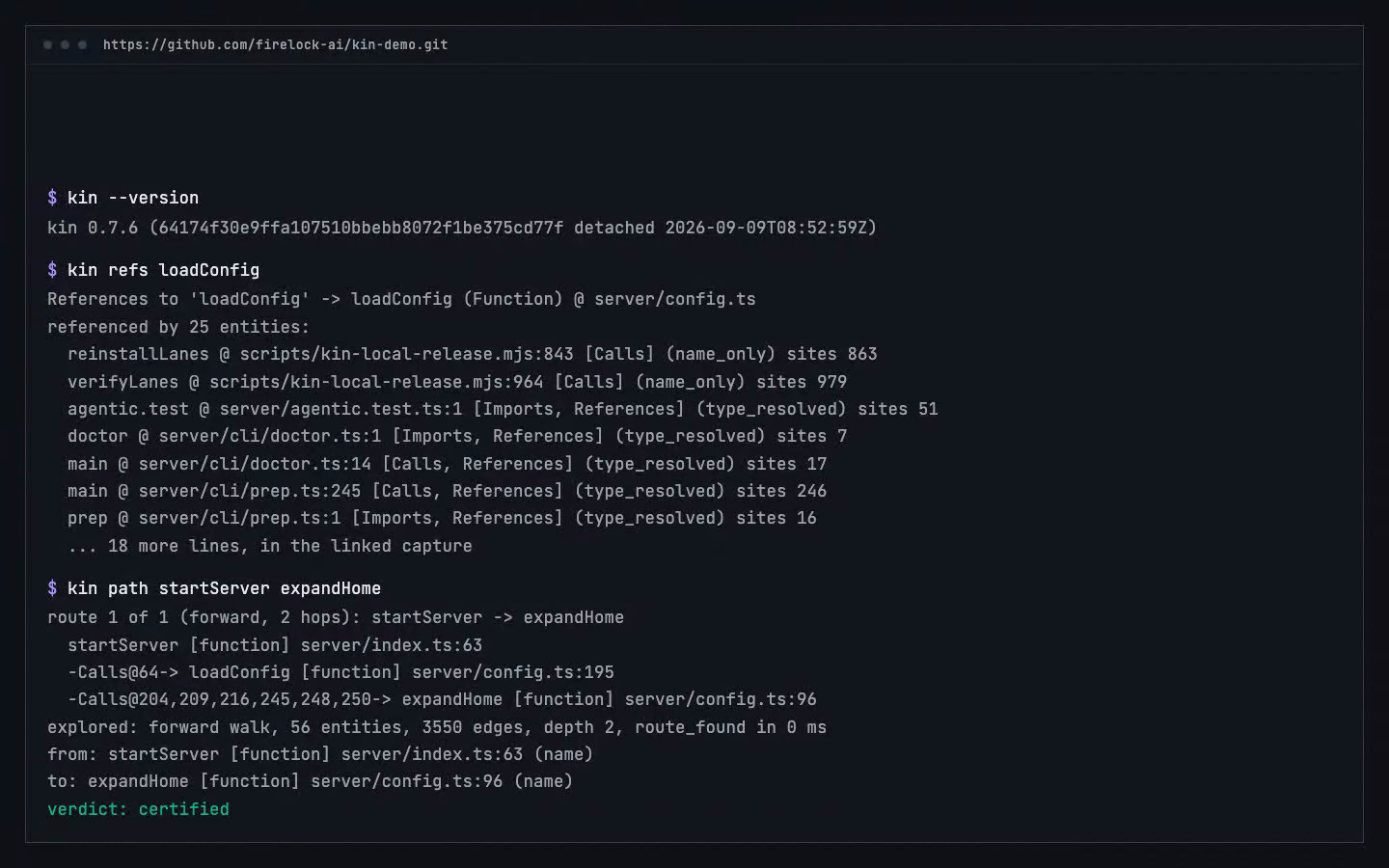
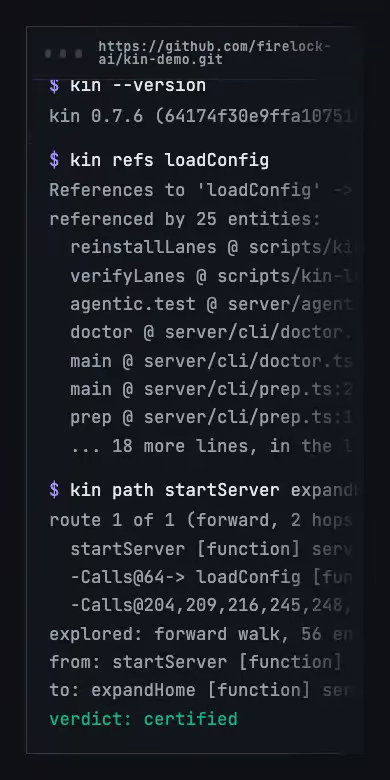
An animation of saved command output.
This animation displays text saved from an earlier Kin run. It shows the version, a list of code connections and the path between two pieces of code. It is not a filmed terminal session.
Saved from the public v0.7.6 archive on a real Git repository. The commands completed successfully. This is a historical example, not a run of the current release.
Check the source files for this example
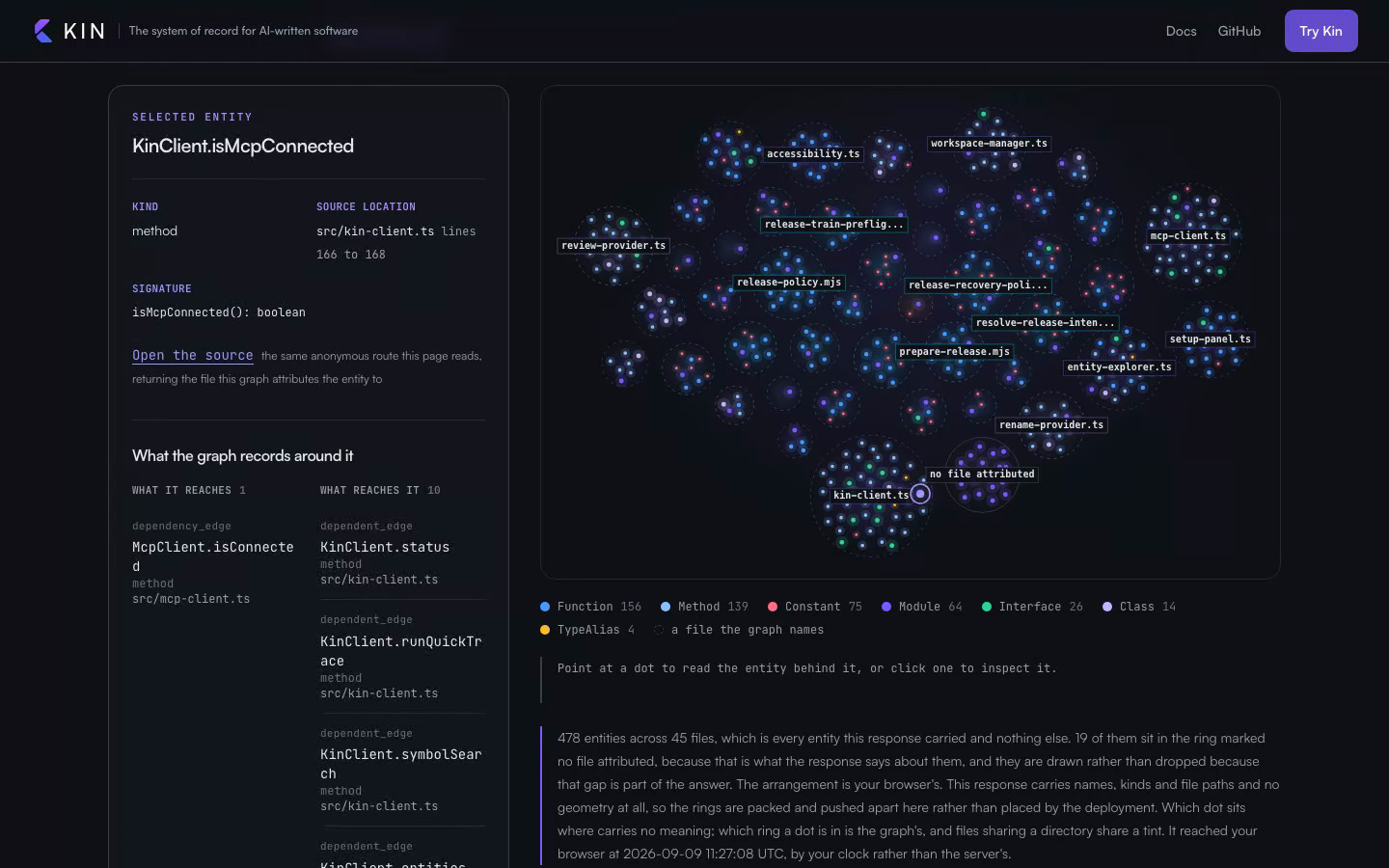
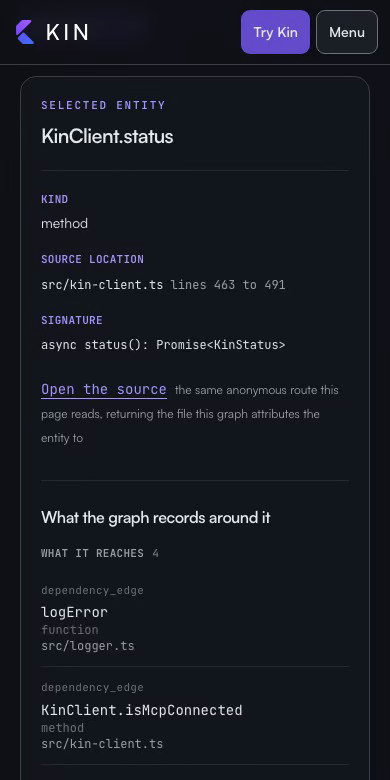
A browser recording of the code explorer.
This browser recording shows someone selecting code and inspecting its saved connections. You can also open the online explorer yourself without an account.
The browser recording captured v0.7.4. It shows that dated session, not the current state of the online explorer.
Check the source files for this example
What we can show you today
Three questions. Here is what answers each one.
Does the repository work as described?
Can code and recorded changes be read back after moving a project into Kin?
Importing a project and keeping its code intact.
In this test, Kin kept the code intact, recorded a rename and retained the change after a restart. The result covers this particular edit.
Read the test method and exact result
The same function read back byte-identically through two separate paths, a three-occurrence rename shown to preserve behavior because the optimized compiler output matched before and after, and a native commit a daemon restart could not disturb.
Checking a published download.
The older download used in the example passed installation checks on the operating systems named in its release record. Those checks belong to that release.
Read the test method and exact result
The v0.7.6 archive above was built, published and checked by its own release run: public install proof on five runners across Linux, Windows and macOS, provenance checks on both published npm packages, and an anonymous install smoke for each.
Read the storage checks
Store size and determinism are kept with the code and checked on every change rather than quoted here. The store-size figures
Does it answer a useful question?
Can the answer help you find related code and check it against the source?
A saved answer about connected code.
Kin returned connections to a piece of code and showed where it was used. The case contains the saved output behind the animation above. It does not establish that every connection was found.
Read the test method and exact result
One function, 25 entities reaching it, and a two-hop route from a caller with the call sites named. The animation above displays saved output from this run; the case record contains the same run with every stream committed and hashed.
Website controls that share a piece of code.
React helps developers build website interfaces. Its text fields, dropdowns and text areas share a small piece of code. This written example shows the saved connections and source you can inspect before changing it.
AI agents meeting that archive for the first time.
AI agents tried the older download in separate environments and wrote reports about what they found. These are AI-agent trials; they do not establish how a person would experience Kin.
Read the test method and exact result
Three independent runs, each an AI agent (Claude Code, running Opus) with no prior knowledge of the archive, each inside its own 6 GiB container, and all three came back with their own written report of what they found.
Does it improve a workflow?
We have not yet shown that Kin improves a complete team workflow on the current release. The design partner program is intended to test a recurring task with a team: how much setup it takes, whether the answer helps and whether people keep using it.
An older comparison test is available, including a result where ordinary text search did better.
Read the older comparison scope
One pre-registered comparison benchmark exists today. It's measured on a Kin commit well behind the current release, and it publishes the axis where a grep-driven baseline came out ahead rather than leaving it out.
Your turn
Ask it something yourself.
Open the online code explorer without an account. Select a point to see the piece of code it represents and the connections recorded around it. The explorer also provides the technical requests if you want to check an answer.
Explore the live graphThe graph also opens on a page of its own. Explore the live graph
Every case above is published in full: the question it asked, what came back, the method it followed and the files behind it.
How a case is built, and what we have not measured The archive Dated released-byte case The saved-output case